
Apache Junction Lookup Record Map
The search should start with the record that answers the narrow question at hand. Property data can confirm a recorded owner, while a court index can place a name in a case. A historical vital image can establish an event. None of those sources alone proves where every Apache Junction resident lives now.
| Official record | What it can confirm | Search point | Access path |
|---|---|---|---|
| Parcel and tax roll | Recorded owner, situs address, separate mailing address, parcel identity | Pinal Assessor and Treasurer | Free web search; ownership is not occupancy |
| Recorded deed | Party spelling, transfer, legal description, and some mailing clues | Pinal Recorder Acclaim | Online index and images from May 23, 1980; staff for earlier records |
| Court index and file | Case role, name variants, dates, events, and disposition | Arizona Public Access, eAccess, or the filing clerk | Free index; eligible documents may cost; restricted matters stay closed |
| Vital record | Birth or death facts and eligible certified evidence | ADHS or participating Pinal registrar | Historical images after statutory release; current copies require eligibility |
| Voter record | One's own status, districts, notices, and voting history | Arizona Voter Information Portal | Self-lookup; other access is limited to purposes authorized by law |
| Entity or license file | Public business role, statutory agent, principal, or credential status | Arizona Corporation Commission or the relevant board | Public search; displayed business addresses are not proof of residence |
Use the parcel route when an address or owner clue is known. Use courts when a case number or legal event is known. Use vital archives for family history, and use entity or license records for a public business tie. That choice keeps the Apache Junction resident lookup focused and reduces false matches.
Apache Junction Court Lookup
The Arizona Public Access Case Lookup covers most state courts and offers party-name and case-number routes after a CAPTCHA. An Apache Junction party search typically begins with last name and may support first name, birth date, and court filters. Data is refreshed weekly, each Friday with information through Wednesday. The index is a finding aid, not the official case file.
Apache Junction has three local paths. Municipal Court handles city ordinance, misdemeanor, and traffic matters. Apache Junction Justice Court, JP6, serves Apache Junction, Gold Canyon, and Queen Valley. Pinal County Superior Court handles civil, felony, family, probate, divorce, and related clerk files. Local ordinance charges, sealed cases, protection orders, mental-health cases, probate cases, victim or witness data, and much juvenile material may be absent from the statewide view.
An Apache Junction court result usually shows case number and court, title, type, filing date, party names and roles, charges or claims, status, judge, and docket events. Correct an error through the court where the matter was filed, not through the statewide host.
Apache Junction Court Records
Arizona eAccess is the document layer for eligible Superior Court civil and criminal files submitted on or after July 1, 2010. It requires an account and sells documents per item or by subscription; electronic certification costs more. Sealed or otherwise restricted images do not appear. Public Access can locate a case, eAccess may supply the image, and the clerk controls the official file.
For older or official Apache Junction material, contact the relevant clerk with the court, case number, party names, and date span. The Pinal Clerk has an Apache Junction satellite at 575 N. Idaho Road, Suite 109, phone 480-982-4166. Apache Junction Justice Court is at the same street address and can be reached at 480-982-2921. Municipal Court's main number is 480-982-8250. Ask whether a file is on site, off site, on microfilm, or electronic, and state whether a plain or certified copy is needed.
Note: Judicial access also follows Arizona Supreme Court Rule 123, so a general public-record request is not the only rule in play.
Verify an Apache Junction Resident
Apache Junction same-name collisions are the main risk in a name search. Middle initials, suffixes, old names, co-parties, parcel descriptions, dates, and known affiliations can separate two people who share a name. Never merge records solely because both results say Apache Junction.
- Start with the most distinct known clue. Search the Pinal Assessor by owner name in its listed last-name-first format, or begin with a parcel, case, entity, or license number.
- Confirm the parcel result against the situs address, APN, subdivision, and legal details. Compare the Treasurer mailing address, but do not treat either owner field as a household list.
- Search Acclaim under the same name. Match a deed by legal description, co-party, record date, and fee number before linking it to the parcel.
- Run the court party search with name variants and a court filter. Use the case number to request the filed record when an index fact matters.
- Use an eligible vital image, obituary, probate file, or entity filing as independent support. Record both matches and conflicts.
- Docket
- The dated list of events and filings in a court case. It describes activity but is not the filed document itself.
- Index versus image
- An index points to a record through names, dates, and identifiers. An image is the document scan and may have a separate access rule or fee.
- Certified copy
- A copy authenticated by the official custodian for uses that require formal proof.
Apache Junction Vital Record Checks
The Arizona Department of Health Services Bureau of Vital Records holds Arizona birth and death certificates, while the Pinal Clerk handles marriage licenses and divorce decrees. Historical access uses a rolling rule. A.R.S. §36-351 sends birth certificates to public archival access after 75 years and death certificates after 50 years. At research time, the genealogy portal stated ranges of 1855 to 1945 for births and 1870 to 1970 for deaths. Those images are not certified copies.
The official ADHS page shows the service channel used for Apache Junction vital-record needs.
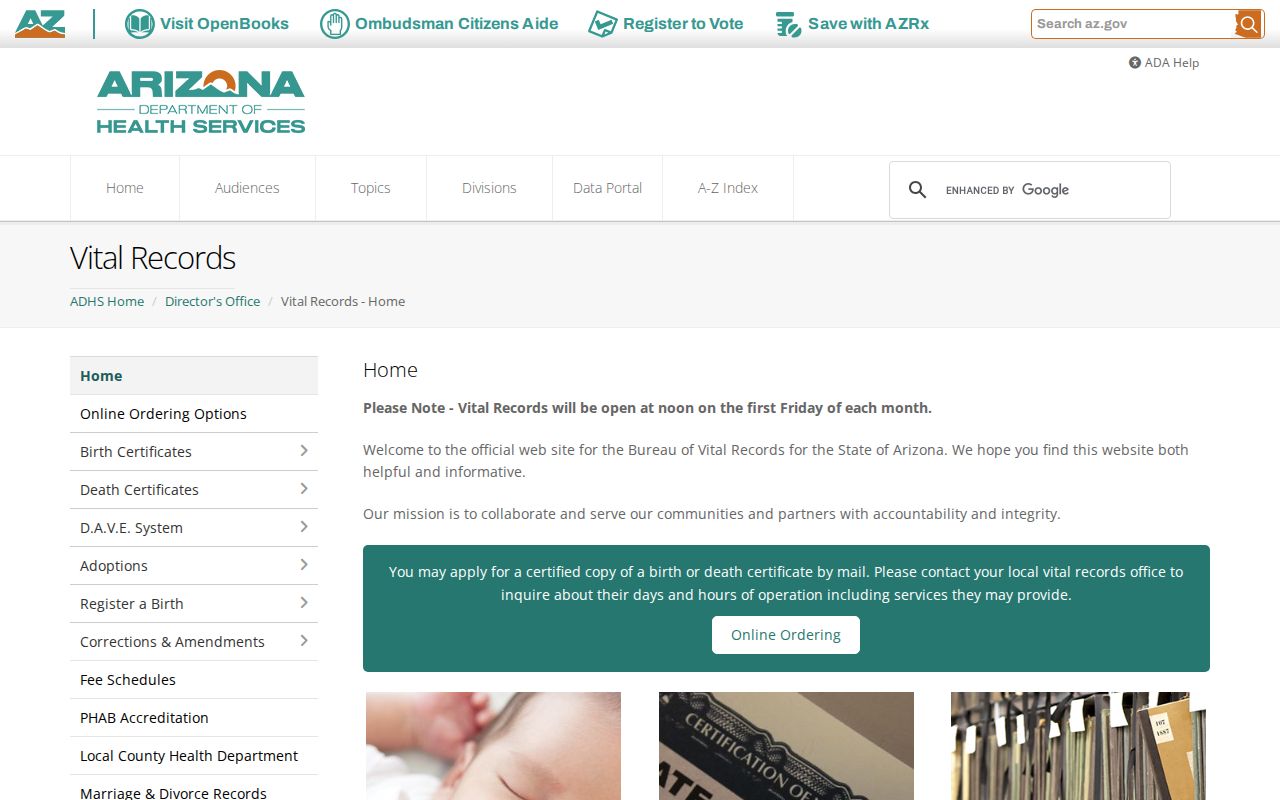
The page is the right starting point for eligibility and application instructions. A current death-certificate application lists a $20 certified copy and requires identity, relationship evidence, an original signature, and the correct payment. The form permits mail and card-payment details, while a notarized signature can replace photo ID only under the form's stated process. A.R.S. §36-324 governs certified-copy access.
For an Apache Junction family-history lead, the Apache Junction Public Library will search local newspapers from 1960 to the present for an obituary if given a name and approximate death date. That service may take up to one week.
Apache Junction Role Lookup
A business or professional record can distinguish people who share a name. The Arizona Corporation Commission entity search accepts entity name, statutory-agent name, principal name, or entity ID, with optional type, status, name-type, and county filters. An official result can show entity name and ID, type, status, formation date, known place of business, agent and address, principals, and filed document images.
Keep an Apache Junction role and residence separate. An agent address, principal address, or known place of business may not be the person's home. Trade names are held by the Secretary of State, while corporations and LLCs belong to the Corporation Commission. The Arizona professional-license directory routes users to the right board for a credential and current status. Contractor, real-estate, liquor, medical, nursing, and other systems have their own fields and custodians.
These sources work well when a resident is known through a firm, licensed service, or public filing. Match the entity ID or license number before relying on a shared name.
Check Apache Junction Custody Carefully
The Pinal County inmate search is an Apache Junction current-jail tool, not a full life history. Its single search box accepts a last name or inmate ID, and the page states that information refreshes every 60 minutes. Release removes a person from the current list. A result does not prove guilt and should be tied to the adjudicating court file before drawing any conclusion.
The Pinal County current inmate search is the manifest source for the live interface.
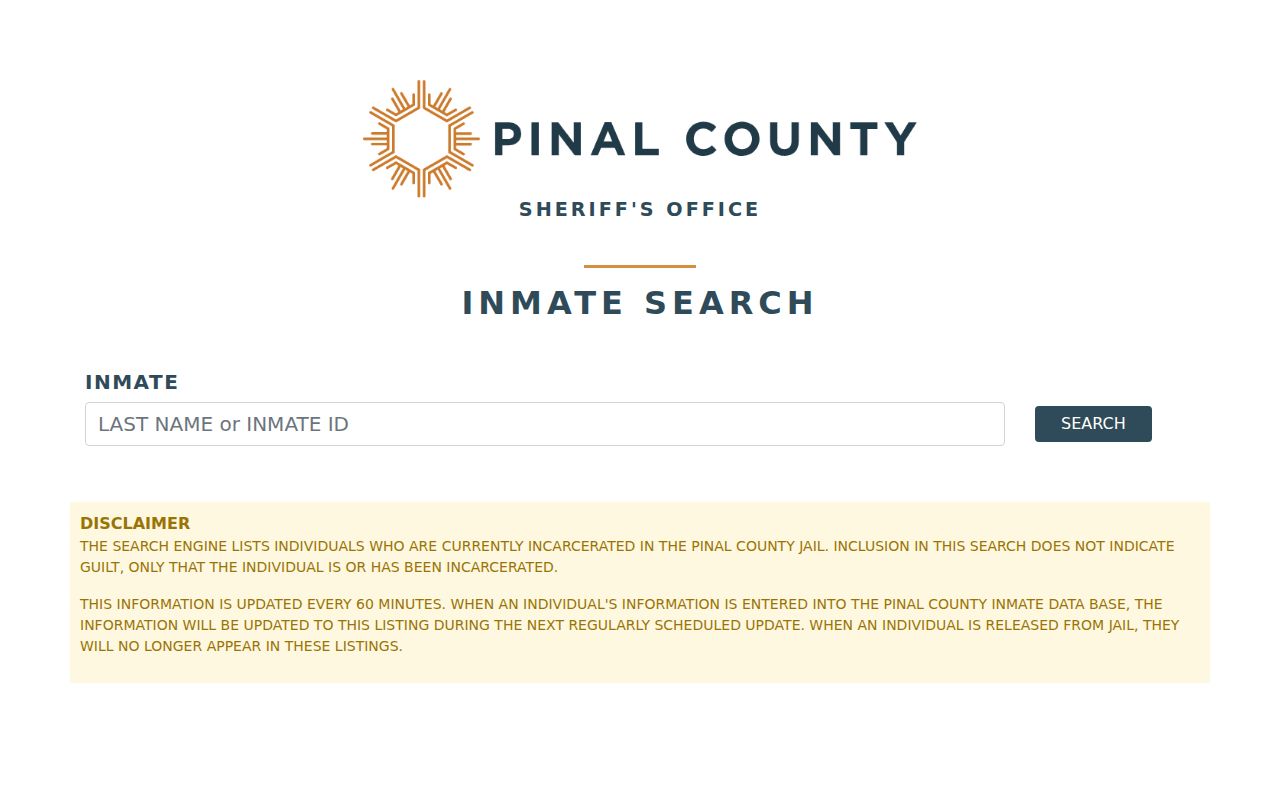
The screenshot shows the narrow input and reinforces the source's limit: it is a current custody check by surname or inmate ID. Arizona state-prison, federal custody, and court records each use separate official systems. Do not treat a blank current-jail result as proof that no older court case exists.
Request Apache Junction Resident Records
When no public index contains the needed Apache Junction document, request the record from its custodian. Arizona Public Records Law, A.R.S. §§39-121 through 39-161, permits inspection by any person during office hours and requires a prompt response, but sets no single statewide day count. A focused request names the department, person or address, record type, and date span. Inspection is free; noncommercial copies may carry reproduction and postage costs.
Apache Junction divides records by keeper. General administrative files go through the City Clerk route, municipal case files go to Municipal Court, and police reports go to the Police Records Section. Pinal court, deed, election, and vital files have their own custodians. Ask for an existing electronic record in its maintained format when useful. If the office needs clarification, narrow the record instead of asking it to "find a person."
An Apache Junction search can also stop for sound reasons. A person may have rented, used a protected address, appeared only in a sealed case, or lacked a distinct identifier. State that limit rather than filling the gap with a guess.
Apache Junction Lookup Privacy Limits
Arizona's voter portal is a self-lookup service for registration status, districts, notices, ballot-by-mail status, and voting history. It is not an open search by neighbor or street. A.R.S. §16-168 restricts voter lists to uses authorized by the statute, bars commercial use and Internet reposting, and withholds sensitive fields. Participation history can show that a person voted, never how a ballot was marked.
The Address Confidentiality Program gives eligible Apache Junction participants a substitute address and mail forwarding under A.R.S. §§41-161, 41-162, and 41-166. Election officials protect the actual address. Real-property instruments require a separate county-record procedure under A.R.S. §11-483. Sealed court matters, restricted vital certificates, protected voter records, crime-victim details, and utility account data set further boundaries.
Lawful personal use. Use an Apache Junction resident lookup for lawful research. Never use a record to stalk, harass, threaten, or harm a person.
If an official result is wrong, contact the office that created the record. An index host often cannot alter the source file. Commercial compilations may merge names or retain old addresses; treat that category only as a lead and verify every claim with the custodian.