
Apache Junction Directory Collections
Apache Junction directory research begins with a modest but useful digital shelf. The Arizona Memory Project place search reported ten directory items tagged to Apache Junction when reviewed. That count does not mean ten straight annual editions. The known books were made for a larger East Valley or Greater Phoenix market, and Apache Junction appears as one of several covered places.
| Historical collection | Years represented | Holding source | How to use it |
|---|---|---|---|
| Mullin-Kille classified directory including Apache Junction | 1958 | Arizona Memory Project | Free digitized PDF; best for firms, professions, churches, schools, clubs, and civic groups |
| Cole's Greater Phoenix cross-reference directory | 1962 | State of Arizona Research Library via Arizona Memory Project | Free online item; 395 MB PDF arranged for address and telephone cross-reference |
| Apache Junction newspapers | 1960 to present | Apache Junction Public Library | Staff obituary search with a name and at least an approximate month and year |
| Pinal County voting registers | 1876 to 1920 | Pinal courthouse records via FamilySearch | Name index; account or affiliate access limits may apply |
| Arizona birth and death archives | Rolling statutory releases | ADHS Genealogy and State Archives | Free uncertified historical images after the applicable release period |
No source reviewed proves a continuous Apache Junction annual directory run. That gap is important. A missing name may reflect an absent edition, a regional catalog title, an unlisted phone, or a person living outside the publisher's scope. It does not prove that the person had left the area.
Apache Junction Before Cityhood
The two verified volumes predate municipal incorporation in 1978. The 1958 book is titled The Mullin-Kille Mesa, Tempe, Chandler and Gilbert (Including Apache Junction, Higley and Queen Creek) Arizona Classified Directory. Its title pages describe a classified work with businesses, industrial plants, professional people, churches, schools, lodges, clubs, and civic institutions. It is strong evidence for public and commercial ties, but it is not a full alphabetical roll of every household.
The 1962 volume is Cole's Directory, Criss Cross/Cross Reference Greater Phoenix. It includes Apache Junction even though the title foregrounds Greater Phoenix. That is a local catalog quirk with real search value. Try the place facet, Pinal and Maricopa County filters, and the phrase "including Apache Junction" rather than searching titles alone. Early names can also sit under Youngsberg Junction, Goldfield, Apache Trail, or simply Pinal County.
That regional setting fits Apache Junction's record history. Before incorporation there was no city clerk holding municipal files. County deeds, tax material, voter registers, census schedules, newspapers, and regional directories carry most of the trail.
Browse Apache Junction Directory Scans
Use the Arizona Memory Project's place and date filters before opening a large file. Search results can be narrowed by item type, place, county, collection, contributor, and date, then sorted by title or earliest date. Item records supply the title, creator, call number, rights statement, and digitization notes. Those details let a researcher cite the right edition even when a page scan is slow to load.
The Apache Junction Archive Center offers a different kind of directory clue through keyword, archive category, time period, and date-range controls.
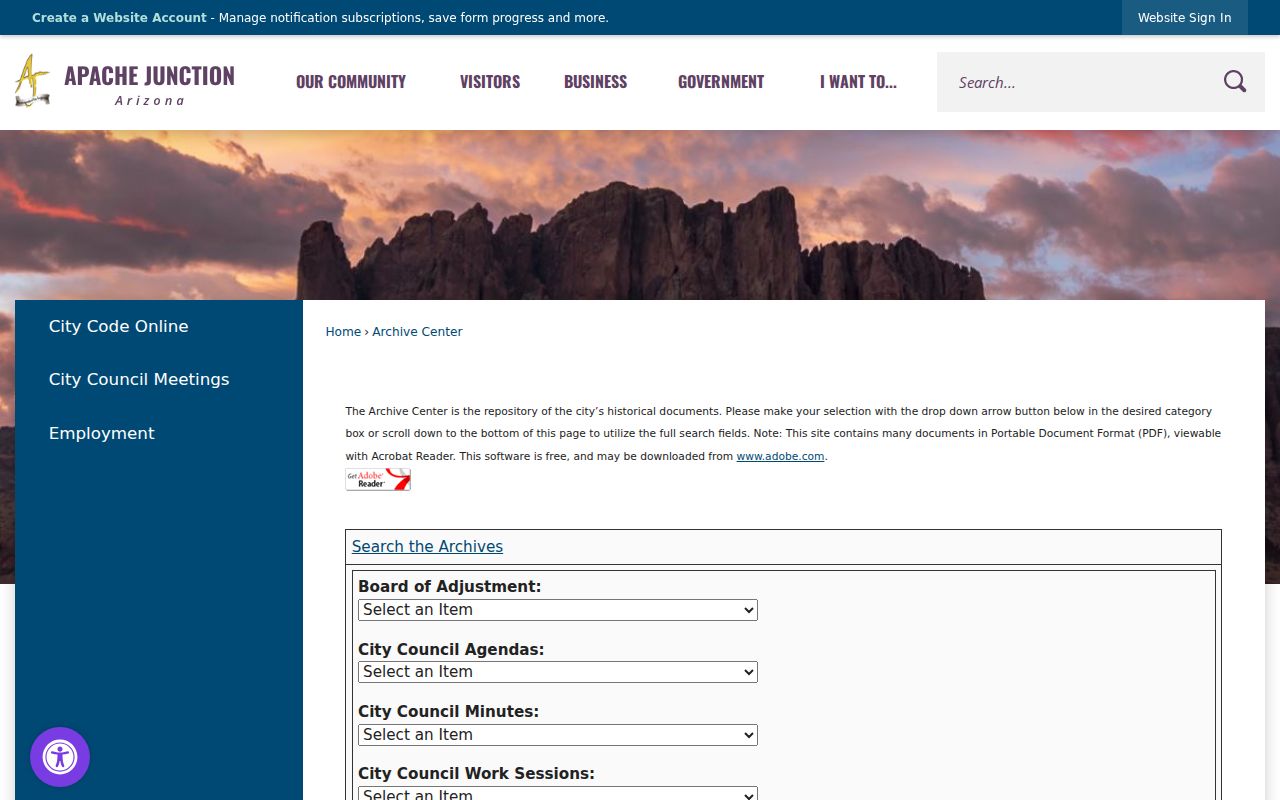
The archive image shows why a name search should be paired with a board, council, or date filter. Results may identify appointees, speakers, applicants, or committee officers, but each name must be read in the document's civic context.
Decode an Apache Junction Directory Entry
An Apache Junction historical entry should be read according to the volume's own purpose. The 1958 Mullin-Kille scan supports business or professional names, classified headings, advertisements, addresses or telephone numbers when printed, and named churches, schools, lodges, clubs, and civic groups. The 1962 Cole's book instead supports an address-first or telephone-first route. Its likely useful fields are street name, house number, listed occupant or subscriber, and phone, but the exact page must be checked before quoting an individual.
| Listed name | The person, firm, or organization printed in that section, not proof of every household member. |
|---|---|
| Heading | The classified trade, profession, church, school, club, or civic category in the 1958 volume. |
| Street and number | The period address used for an address-first search in a cross-reference volume. |
| Telephone | The listed subscriber's number, which may name one person for a larger household. |
| Publisher data | The edition title, covered towns, copyright credit, and other facts used to cite the source. |
- Criss-cross directory
- A book arranged by street address or phone so a researcher can move from a place or number to a listed name.
- Householder index
- An index centered on the named household head or subscriber, not a count of all people at the address.
- Abbreviation key
- The publisher's legend for shortened terms. Check it before interpreting any mark or code in an entry.
Apache Junction Library Name Trails
Apache Junction Public Library, at 1177 N. Idaho Road, fills one of the largest gaps in the historical shelf. Its newspaper holdings run from 1960 to the present. Staff will search for an obituary when given the first and last name plus at least the month and year of death. More detail improves the result. High demand can make the response take up to one week, and out-of-area help is limited to local facts.
The library also reports three genealogy or family-history databases reached through Research and Genealogy. An Easy Access card includes database and computer use with photo ID, though remote access depends on the database. Public computers, Wi-Fi, a scanner, and print or copy services help with large source files. The Pinal County library catalog can locate other items, while interlibrary loan may be requested at the service desk if the county system lacks a title.
Note: Ask staff about access and format before visiting, since the official research did not verify a dedicated directory shelf or microfilm run.
Trace Apache Junction Directory Families
A sound family-history search preserves each source's limits. Start with a period-correct address, then move between address, name, and event records. Apache Junction developed fast after mid-century, so modern city limits and postal labels should not be forced onto an older census or deed.
- Fix the likely year and address from a deed, legal description, family paper, or newspaper notice.
- Search the 1962 Cole's cross-reference by street and house number. Treat the returned person as a subscriber or listed occupant, not automatically the owner.
- Check the 1958 classified volume for a business, profession, school, church, lodge, club, or other community tie.
- Pair the directory clue with the 1950 census, the latest public federal census, using the period township or precinct.
- Check Pinal deeds and assessor data for ownership. The Recorder's online images begin in 1980, so earlier work may require staff and older books.
- When the trail stops, ask the library for an obituary search and check probate or archival death records when eligible.
A disappearance from the directory may mean a move, death, changed listing, or a publication gap. An obituary, later deed, probate file, or next census supplies a firmer answer. For a modern identity check, use the separate Apache Junction resident lookup workflow rather than treating an old listing as current.
Extend Apache Junction Directory Gaps
Historical voter registers and vital indexes can carry an Apache Junction name beyond the thin directory shelf. The Pinal County voting-register collection spans 1876 through 1920 and contains 24,047 indexed records. Search fields include first names, last names, birthplace, birth year, and more options. The records may preserve a precinct and naturalization context, but Apache Junction's modern name may not appear in the earliest material.
Arizona's public genealogy certificates follow a rolling rule. Birth certificates transfer for public archive access after 75 years and death certificates after 50 years under A.R.S. §36-351. The ADHS Genealogy portal supplies historical images, not certified copies. Pinal's birth register for 1887 to 1910 and death register for 1887 to 1908 also survive on digitized microfilm, with access restrictions varying by login or FamilySearch affiliate site.
These records identify events, not a continuous address. Keep the printed entry, census household, voter register, and certificate as separate claims until names, dates, and places align.
Apache Junction Directory Story Leads
The library's Apache Junction History collection preserves locally authored essays and points researchers to the Arizona History Collection, the Apache Junction/Gold Canyon Independent, and the Superstition Mountain Museum. A narrative may supply a mine, road, spouse, business, or date that unlocks a formal index. It remains a lead until checked against primary records.
Place names matter as much as surnames. Gold mining and the Apache Trail produced early named-person material. The settlement was once called Youngsberg Junction, and Apache Junction did not incorporate until November 24, 1978. US 60's later move south also shifted commercial activity away from the old Apache Trail strip. Searching those older names and road references can recover an entry missed by a modern place-only query.
Note: A biographical database or local essay can point toward a person, but a blank result never proves that person was absent.
Limits of Apache Junction City Directories
A printed directory is selective. The 1958 classified work favors public-facing organizations and trades. The 1962 cross-reference follows listed addresses and phones. Neither volume proves every person who slept at an address, and neither proves legal ownership. Seasonal residents, unlisted phones, shared households, manufactured-home parks, and rural delivery patterns make those gaps more pronounced in Apache Junction.
The local mix also makes owner and occupant diverge. A city planning survey found that manufactured or mobile homes and park-model or RV units together formed nearly two-thirds of surveyed units. A parcel can name a park or landowner while the book names a subscriber. Preserve both facts without merging them.
Use a directory entry to form the next question. Then verify with a deed, census, newspaper, probate file, or eligible vital record. That measured chain turns a scarce Apache Junction directory collection into reliable family and place history without claiming more than the source shows.