
Finding Apache Junction Residents
Begin with the one fact already known. A street address points first to the city GIS and Pinal County parcel roll. A name points to the assessor, recorded-document index, court search, and public business records. An older name or address belongs in newspaper files, vital indexes, and regional directories. Apache Junction lies mainly in Pinal County, but the city reaches into Maricopa County, so the parcel location decides which county office holds a land record.
No official source lists every person in a home. Property systems show owners, not all occupants. Arizona's voter tool is for a voter to confirm their own registration, not for public browsing by neighbor. Court and deed indexes document a legal event, while printed directories and newspapers preserve a dated local presence. The Apache Junction residents directory works best as a chain of evidence, with two independent sources used when names repeat.
- Validate the address and county, then capture the assessor parcel number, or APN.
- Search the county assessor by owner or property address.
- Carry the owner name and legal description into the recorder index.
- Check court, city, business, or vital sources that fit the question.
- Ask the correct clerk, library, or archive when the online trail stops.
For a full address-first method, the Apache Junction street directory follows the parcel and deed chain without turning ownership into a claim about occupancy.
Apache Junction Records Custodians
Custody follows the record. Apache Junction City Clerk handles general city files such as council material, ordinances, board rosters, contracts, and specified license records. Municipal Court keeps its own case files. Pinal County offices hold most parcel, deed, probate, marriage, divorce, and superior-court material. A request should name the department, person or address, record type, and date span. Arizona Public Records Law permits inspection during office hours and requires a prompt response, but it sets no single response deadline for all requests.
Apache Junction City Clerk
300 E. Superstition Boulevard
Apache Junction, AZ 85119
480-982-8002
Pinal Superior Court Clerk
575 N. Idaho Road, Suite 109
Apache Junction, AZ
480-982-4166
Pinal court and probate files
Apache Junction Public Library
1177 N. Idaho Road
Apache Junction, AZ 85119
480-474-8555
Newspapers and genealogy help
For recorded instruments that predate web coverage, the Pinal County Recorder also accepts counter requests at 31 N. Pinal Street, Building E, in Florence and mail requests at PO Box 848, Florence, AZ 85132. That offline route matters in Apache Junction research.
Apache Junction Parcel Record Searches
The Pinal County Assessor Parcel Search is the strongest first roll for most Apache Junction addresses. It has six distinct search routes, so a missing result under one field does not end the search. Owner names use last-name-first order. Address fields split the number, direction, street name, and suffix. Parcel, subdivision, public-land survey, and recorded-plat fields offer other ways to locate the same land.
| Search route | Fields to enter | Best use |
|---|---|---|
| Owner | Last name, then first name | Find parcels tied to one recorded owner |
| Property address | Number, direction, name, suffix | Resolve one current situs address |
| Parcel number | Book, map, parcel, suffix | Carry an exact APN between systems |
| Subdivision | Subdivision name | Browse a named development |
| Survey | Section, township, range | Locate land by public survey |
| Recorded plat | Cabinet, slide, lot | Match a lot to its plat reference |
The official Assessor interface shows how Apache Junction residents directory work moves from a loose clue to an exact parcel.
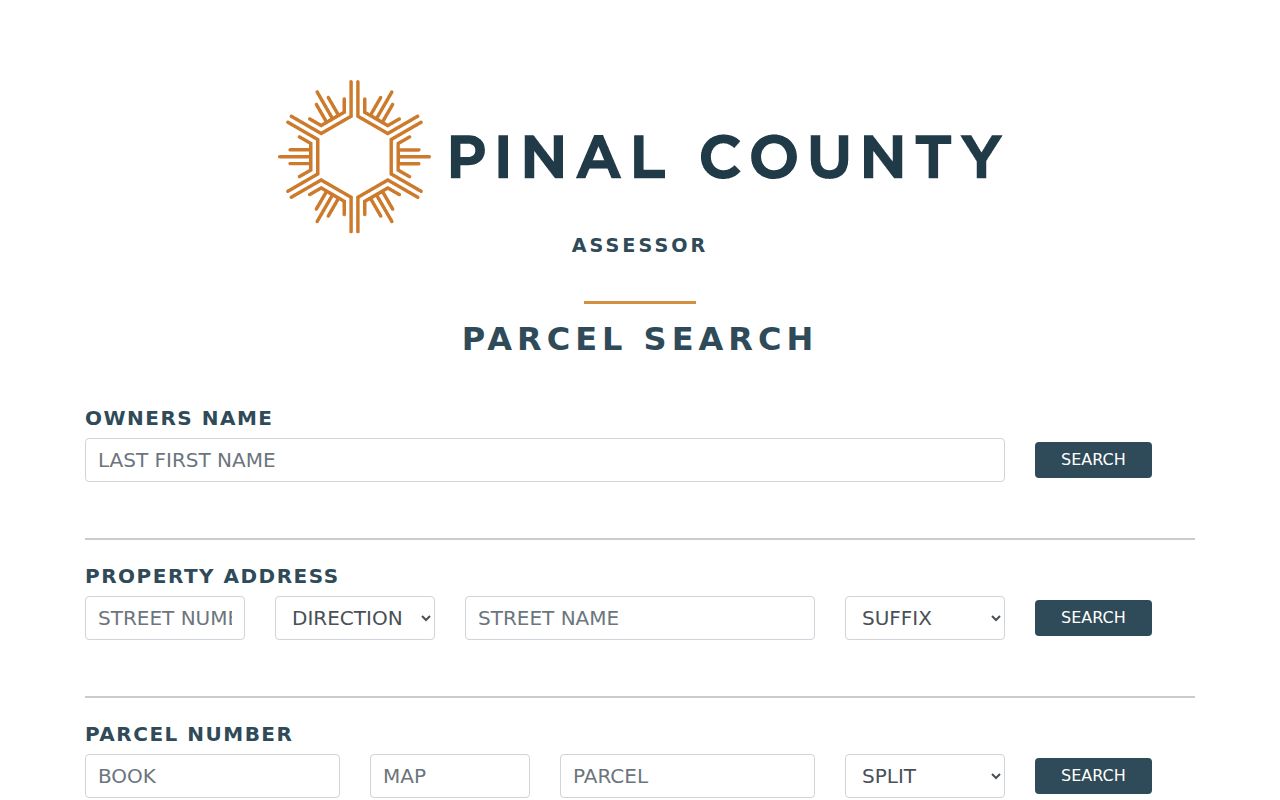
The captured screen confirms that owner, address, parcel, subdivision, survey, and plat searches are separate paths. Save the APN and legal details before moving to tax or deed records.
Apache Junction Resident Ownership Limits
A parcel result must be read with care. The assessor identifies the owner of record and the physical property address, also called the situs address. The Pinal Treasurer adds the tax-bill mailing destination and updates its inquiry nightly. A different mailing address may point to an absentee owner, a trust, a business, or merely a preferred place for mail. It does not name the person sleeping at the property.
This distinction is especially important in Apache Junction. A city dwelling survey found that nearly two-thirds of the surveyed units were manufactured or mobile homes, park models, or recreational vehicles. A parcel can therefore identify a park or landowner while a seasonal occupant appears only in a dated directory, newspaper item, mail source, or private association record. Official property rolls are precise about ownership, but they are not a complete Apache Junction residents directory.
- Parcel
- A legally tracked piece of land with its own assessor number.
- Situs address
- The physical location of the parcel, distinct from the owner's mailing address.
- Index
- A finding aid that points to a record; it is not always the full document.
- Criss-cross directory
- A historical volume arranged by address or phone so a place can lead to a name.
Note: Ownership and occupancy are different facts, so never label an assessor result as a full household roster.
Apache Junction Resident Deed Trails
The Pinal County Recorder indexes deeds, deeds of trust, releases, liens, plats, and other instruments by party and land clues. The official county research establishes that online coverage begins May 23, 1980. Search a current owner as grantee, meaning the buyer or recipient, then confirm the same legal description. Record the seller, document number, type, and date. Repeating that process can move backward through an Apache Junction ownership chain.
Online PDFs are unofficial watermarked copies. A plain recorded copy costs $1 per page, and certification adds $3 per document. Requests may be made online, by email, by mail, or at the Florence counter. Older instruments require staff, deed-book, microfilm, or archive work, beginning with the current deed's grantor, meaning the seller, and legal description. An empty web result before the cutoff never proves that no deed exists.
Keep the legal description. A lot, block, subdivision, or other legal description remains the continuity key when street labels or mailing details change.
Apache Junction Court Record Checks
The Arizona Public Access case lookup covers most state courts and is updated weekly. It can expose a case number, court, case type, filing date, party roles, disposition, judge, and docket, the chronological list of case events. Yet it is informational, not the official file. Sealed cases, protective orders, probate, mental-health matters, victim or witness data, most juvenile delinquency material, and local-ordinance charges are excluded.
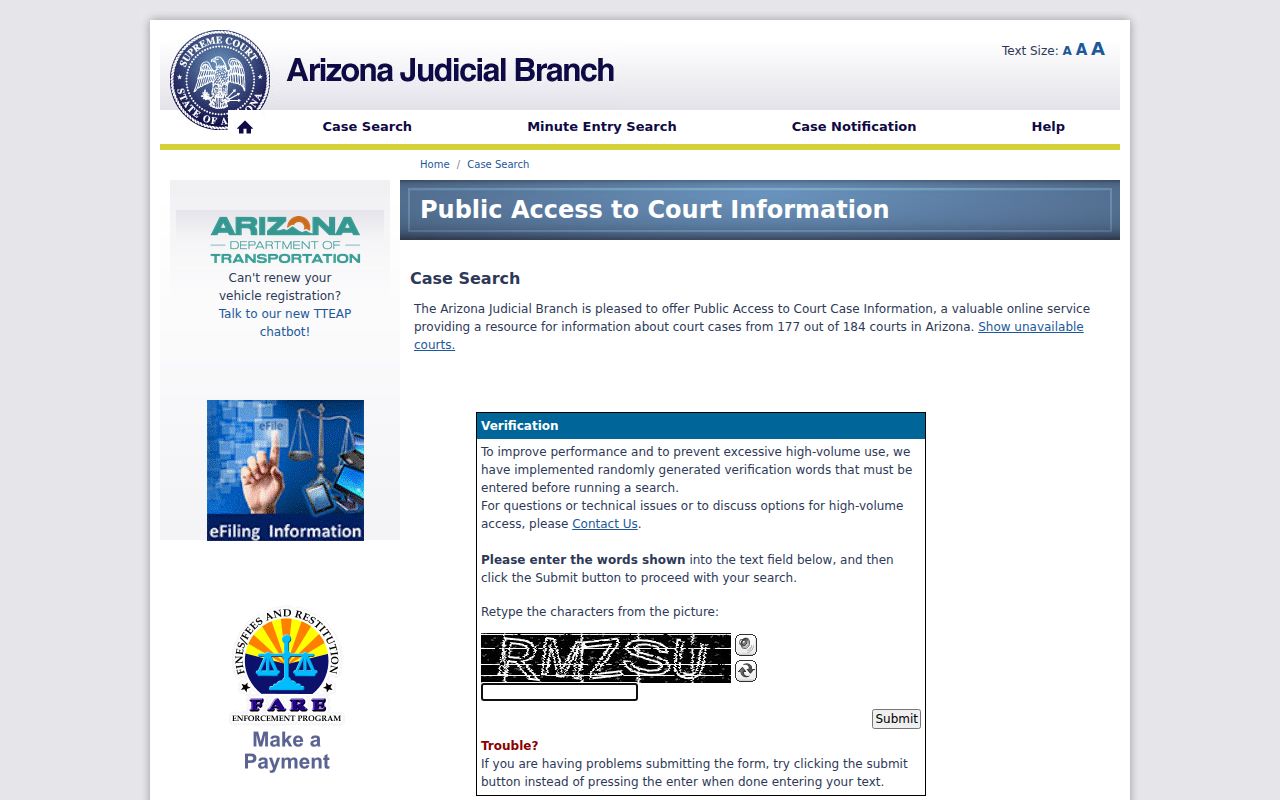
The statewide screen is a broad name-search checkpoint. Confirm any match with Apache Junction Municipal Court, Justice Court precinct six, or the Pinal Superior Court clerk before treating it as the correct person.
Eligible Superior Court civil and criminal documents filed from July 1, 2010 forward are offered through Arizona eAccess. The service requires registration and charges for documents or subscriptions.
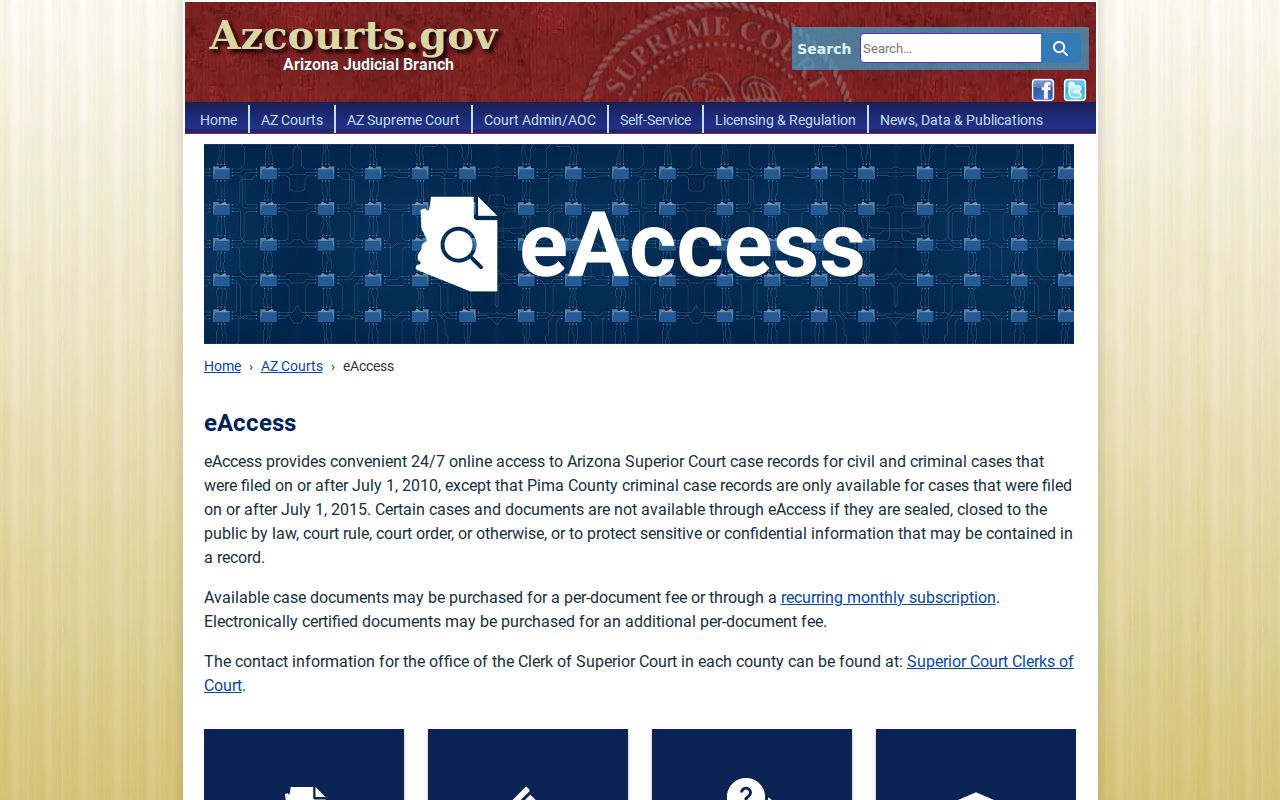
The eAccess page illustrates the divide between a free index and paid document access. The local clerk remains the custodian for certified, older, or otherwise unavailable files.
| Channel | What it supplies | Main limit |
|---|---|---|
| Public Access | Free statewide case and docket clues | Not official and excludes protected classes |
| eAccess | Eligible Superior Court document images | Registration, fees, and a filing-date cutoff |
| Court clerk | Official file, copies, and archive guidance | Retrieval and copy rules vary by file |
Current Apache Junction Directory Sources
No current Apache Junction residents directory covers all households. Each official roll answers a narrower question, and access differs by custodian. Property and recorded-document indexes are open online. The voter self-service system confirms the requester's own file. City staff and chamber directories list public or organizational roles rather than private household members.
| Resident clue | People or links shown | Keeper | Access path |
|---|---|---|---|
| Parcel and tax roll | Recorded owners and mailing clues | Pinal Assessor and Treasurer | Free online search |
| Recorded instruments | Parties to deeds, liens, and releases | Pinal Recorder | Web index, mail, or counter |
| Voter registration | One voter's status and districts | Arizona and Pinal Elections | Identity-based self-lookup |
| City staff directory | Employees, titles, and public contacts | City of Apache Junction | Name and category search |
| Chamber directory | Organizations and public-facing contacts | Apache Junction Area Chamber | Keyword, category, ZIP, alphabet |
The Apache Junction staff directory searches by category, first name, and last name. Results can show an employee's name, title, public email, and direct or main phone.
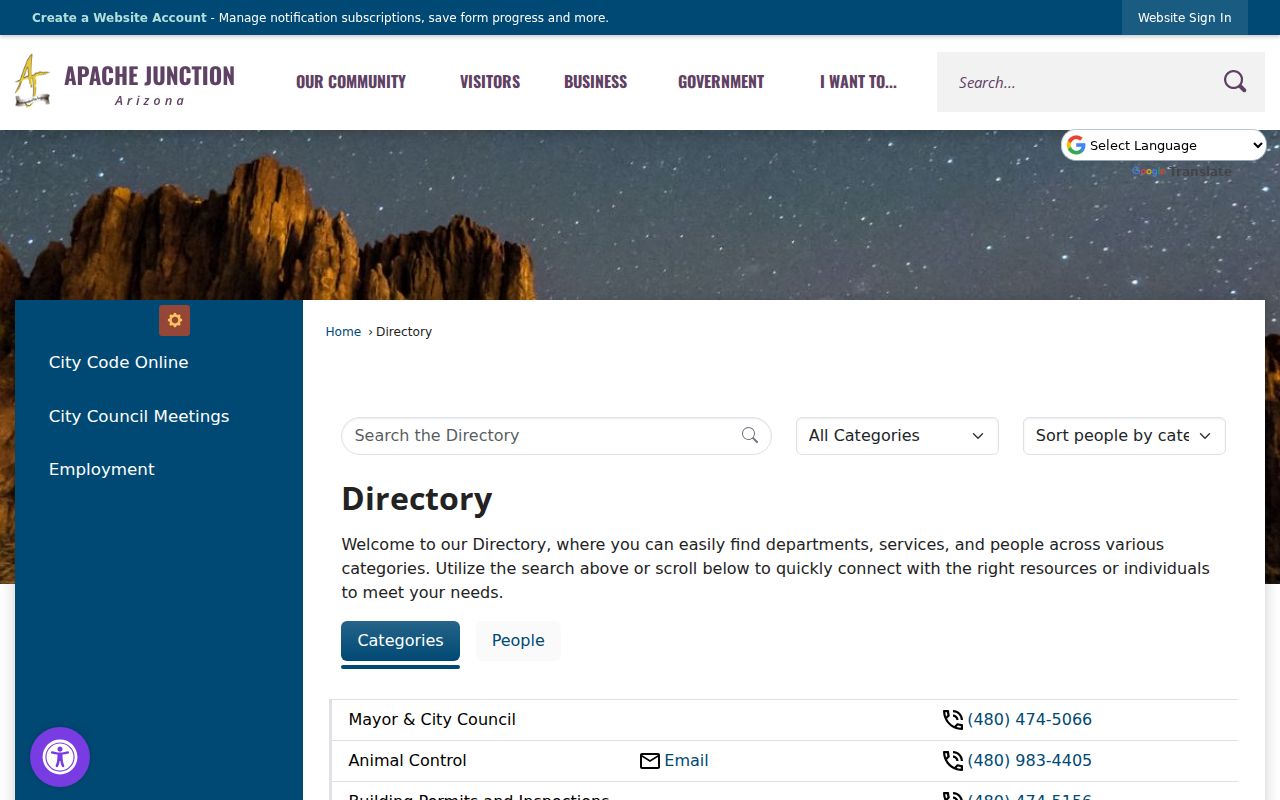
The city screen is useful for finding the correct public contact, not for proving where an employee lives.
Apache Junction Voter Record Privacy
Arizona's Voter Information Portal lets a voter review their own registration status, election districts, notices, ballot-by-mail status, and voting history. It is not an open Apache Junction neighbor search. State law allows specified voter-list inspection only for authorized political, election, redistricting, or other uses that the law names. Commercial use and Internet reposting are prohibited.
Even an authorized list omits the month and day of birth, Social Security information, driver or state ID number, tribal census number, parental identifiers, signature, and email. Email cannot be released for any purpose. Participation history shows only that someone voted, never the marked ballot. Protected people and Address Confidentiality Program participants may have voter identifying information sealed. Inactive status also should not be treated as proof that a person moved.
Use resident records lawfully. Do not use directory clues to stalk, harass, threaten, or expose a protected address.
Apache Junction Archive Records
City records became far more searchable in 2025. Apache Junction announced a new online archive reaching back to incorporation in 1978, with council minutes, ordinances, resolutions, and proclamations in its initial release. These files can preserve the names of officials, applicants, appointees, speakers, honorees, and other people tied to public city business. More categories are planned.
The Apache Junction public records archive is the new entry point.
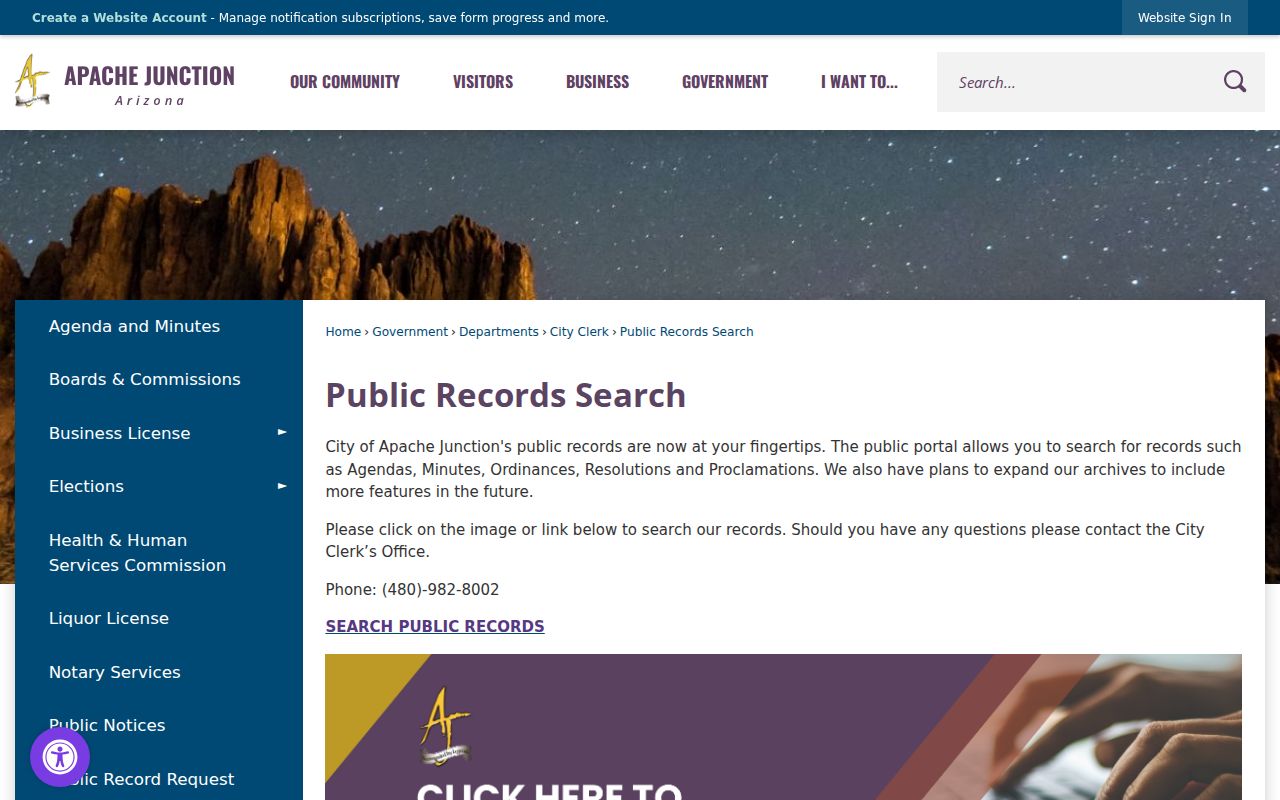
The captured landing page confirms the city-level digital trail. The older Archive Center still provides category, keyword, time-period, and date-range searching for boards, commissions, council files, and campaign-finance records. Search both systems during the archive expansion, then ask City Clerk for a missing record.
The date boundary changes the search. Apache Junction incorporated on November 24, 1978, after seven failed incorporation efforts. A special census in 1979 counted 10,151 people, up from 2,390 in the 1970 federal count. Municipal records are therefore meaningful only from incorporation onward. Earlier Apache Junction names, parcels, and public events belong mainly in Pinal County deeds, tax records, court and election material, federal census schedules, and newspaper collections. The repository changes with the era, not just with the type of record sought.
Apache Junction Business Record Connections
A public business record can distinguish two people with the same name or connect a person to a known organization. Arizona splits custody. Corporations and limited liability companies belong to the Arizona Corporation Commission, while the Secretary of State handles trade names, trademarks, partnerships, UCC filings, and notaries. Professional credentials route to the board that regulates that field. A business or statutory-agent address may be an office, mailing point, or service address, so it should not be called a home.
The Arizona Corporation Commission entity search accepts entity, statutory-agent, and principal details, with a Pinal County filter.

The search screen adds an affiliation check to the Apache Junction residents directory workflow. Confirm entity status, addresses, agent role, and filing dates together instead of matching a name alone.
Apache Junction Historical Vital Records
Arizona transfers birth certificates for public archive access 75 years after birth and death certificates 50 years after death. This rolling rule creates a reliable genealogy channel while protecting newer records. The Arizona Department of Health Services genealogy portal currently states birth coverage from 1855 through 1945 and death coverage from 1870 through 1970. Public images are not certified copies.
The ADHS historical genealogy search supplies the public index and images.
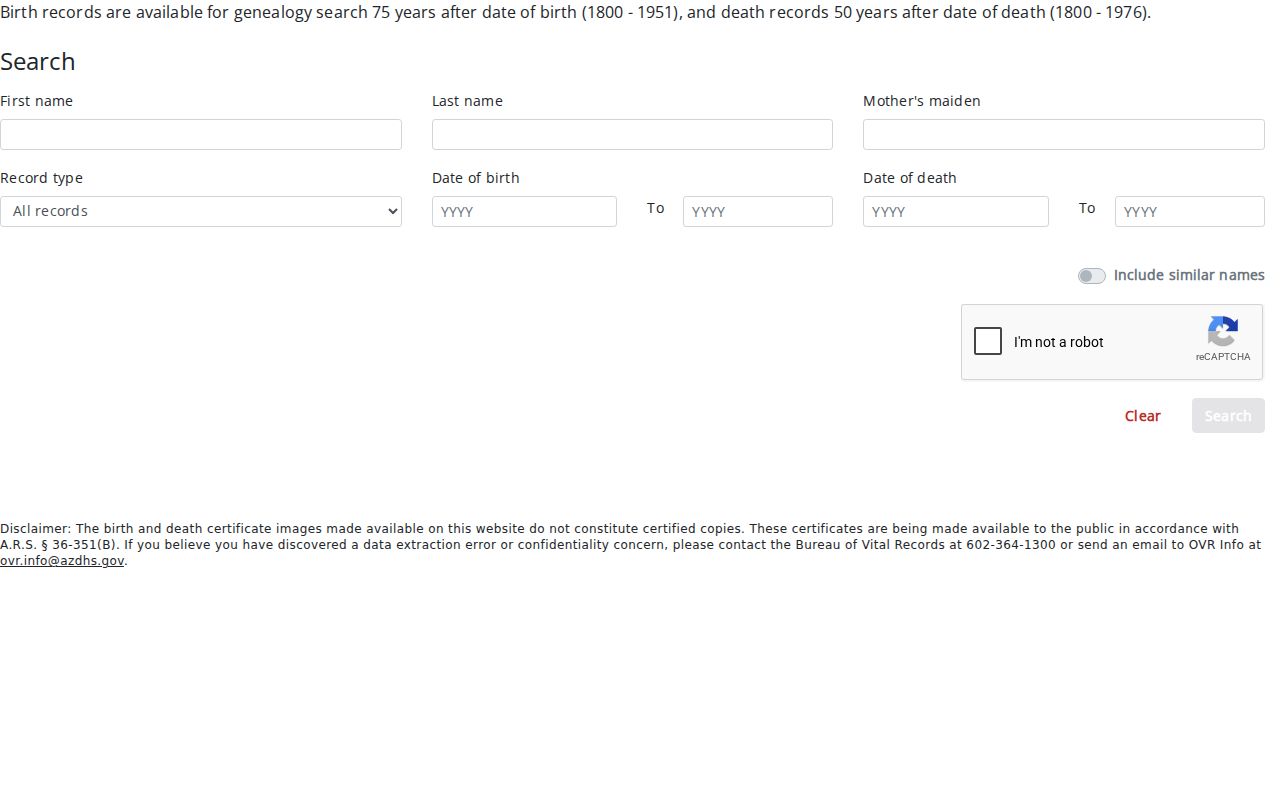
The state screen gives a name-based path into old identity records. Current certified birth and death copies remain eligibility-controlled, and marriage licenses or divorce decrees belong with the Pinal Superior Court clerk rather than ADHS.
Apache Junction Obituary Record Research
Apache Junction Public Library fills a gap that parcel and court systems cannot. Its local newspaper holdings run from 1960 to the present. Staff will search for an obituary when given at least a first and last name, preferably with the month and year of death. Heavy demand can make an obituary response take up to one week, while ordinary email reference help may take three working days.
The library genealogy and obituary guidance explains the service and access options.
The library page points researchers toward a named local presence in newspapers. Obituaries can connect relatives, former addresses, clubs, and burial clues, but each fact should be checked against a vital, probate, or land source.
Older Apache Junction Resident Directories
Apache Junction appears in regional directories before the city's 1978 incorporation. A verified 1958 Mullin-Kille regional directory includes Apache Junction, and a 1962 Cole's volume is arranged as a cross-reference, or criss-cross, directory. That address-first format can connect a historical address with the listed subscriber or householder. It is still a dated publication, not proof of every person present.
Before incorporation, most official evidence belongs to Pinal County, territorial, mining, federal-land, census, and newspaper collections rather than a city office. The name also changed over time. Early research may need Youngsberg, Youngsberg Junction, Apache Trail, Goldfield, or Pinal County as place terms. The Apache Junction Public Library and Arizona Memory supply the local and digitized entry points. The full shelf and reading method are covered in the Apache Junction city directory collection.
Road history adds another key. The route built from Mesa for Roosevelt Dam construction in 1905 became the Apache Trail after Theodore Roosevelt traveled it for the 1911 dedication. A highway toward Superior and Globe was completed in 1922, and the junction helped give the community its lasting name. George Cleveland Curtis homesteaded nearby in 1923 and built the Apache Junction Inn. After World War II, winter visitors, residences, and recreational vehicle parks reshaped the local population. Older advertisements may cluster along Apache Trail, while later records reflect the relocation of US 60 to the south in the early 1990s. Place names and road context help separate records that a modern city-only query would miss.
Apache Junction Records Fallbacks
A failed portal is a routing signal. Recorder records before the online cutoff move to staff, the Florence counter, mail, microfilm, or older deed books. A court result that is missing, sealed, or too old moves to the clerk of the court where it was filed. A city document not in either archive should be requested from the City Clerk or the separate municipal court or police custodian. Historical names move to the library, State Archives, Arizona Memory, or FamilySearch access points.
Arizona Public Records Law allows any person to inspect open records during office hours. Inspection is free. Noncommercial copy charges may reflect reproduction and postage, while a request for commercial purposes has distinct rules. Agencies must respond promptly, though volume, redaction, complexity, and storage location affect timing. State archives staff can also route records that were transferred from an agency.
Official rolls offer known custody, stated coverage, and a path to certified copies. Commercial people-finder compilations may combine stale or mismatched data and charge recurring fees. They are leads at most. For Apache Junction resident research, the custodian's record should control.
Protected Apache Junction Resident Addresses
Arizona's Address Confidentiality Program gives eligible relocated victims a substitute address and mail forwarding through the Secretary of State. State and local agencies generally accept the substitute address for new public records, and election officials keep the actual location confidential while assigning the correct precinct. Real-property instruments require a separate county-record procedure, so program enrollment does not automatically rewrite every old deed or web page.
Other laws restrict voter identifying details, crime-victim locating information, utility customer data, and motor-vehicle records. Redaction or a missing portal field does not mean the custodian lacks the information. It means access may yield to a safety rule, privacy statute, court order, or a case-specific review. The Apache Junction residents directory should never be treated as a tool for bypassing those protections.
Note: Verify a public record with its custodian, and stop when a lawful safety or confidentiality boundary blocks disclosure.